
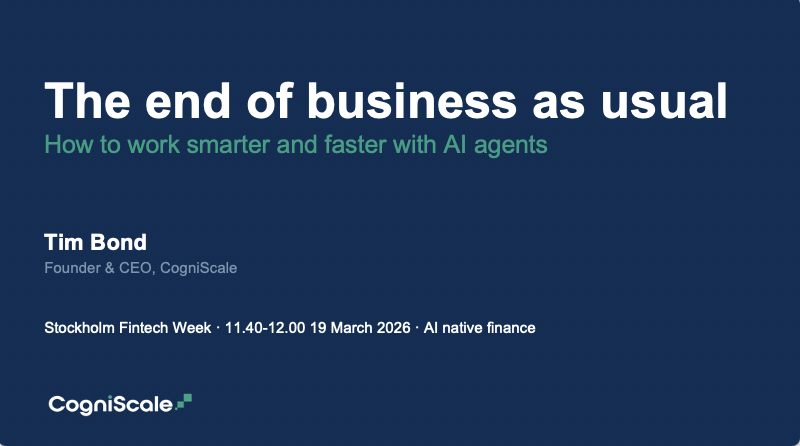
Last week I spoke at Stockholm Fintech Week on the AI Native Finance track. The talk was called "The end of business as usual" and covered what we've learnt at CogniScale helping enterprise teams build AI agents for their workflows.
In early 2023, my content marketing business was under pressure. We had eight copywriters producing executive interview summaries. Two or three were excellent. The rest were inconsistent. Rewrites were common and timelines slipped. Then I fed an interview transcript through Claude - Anthropic's large language model - and what came back was better than most of what our writers were producing. Not just faster. Better structured, more consistent, requiring zero rewrites.
Within twelve months we'd reduced content production costs by 75% and were delivering finished work four times faster. We started helping our clients follow the same path, starting with the Copenhagen based Fintech SimCorp who experienced 86% time savings on key workflows. This led to the launch of CogniScale, our mission is to build high performance businesses for the AI era - human-first organisations powered by AI.
The momentum is building
This isn't an experiment any more. Bank of New York now has 134 digital employees on its org chart and 20,000 staff building agents. Their CEO Robin Vince says his mantra is "AI is for everyone, everywhere, everything." Goldman Sachs describes its AI agents as digital co-workers for professions that are scaled, complex and process-intensive. Janet Truncale, the CEO of EY, expects to double in size with the workforce she has today.
Yet the gap between these leaders and the rest is widening. PwC's January 2026 Global CEO Survey found 56% of CEOs report no revenue or cost impact from AI. Gartner told me in March that over half of all generative AI projects across enterprises have been scrapped and they expect it to get worse, predicting that by 2028, seventy percent will be decommissioned.
The question I'm asked most often by senior leaders is straightforward: if AI is this capable, why aren't more organisations seeing results? The answer is that most are getting six things wrong.
1. Buying the wrong technology
Many organisations equate "we have AI" with enabling Microsoft 365 Copilot. Copilot enhances individual tasks inside Word, Excel and Outlook. But enterprise AI transformation requires something different: agents that handle entire workflows end to end, with autonomous reasoning, skills and deep research and connections to your data. When the C-suite's only experience is a chatbot that summarises a Teams call, it's no wonder they underestimate what's possible. Claude Teams and Enterprise is a native frontier Large Language Model (LLM) built for enterprise rather than augmenting existing work platforms like Microsoft 365 or Google workspace. I will address model options and comparison in a separate article later this year.
2. Over-ambitious projects
Over 80% of AI projects fail before reaching production more than twice the failure rate of traditional IT projects. The root cause is chasing system integrations instead of starting with contained, high-value workflows. The organisations getting results start with agents built on approved data uploaded manually to customised agents. They then work with IT later on a governance plan and an integration roadmap.
3. Leadership as a spectator sport
If the C-suite treats AI as something the frontline should figure out while they watch from the boardroom, the programme will fail. Leaders need to use agents on their own work - not sit through a demo. At CogniScale, our leadership immersions put executives in front of agents built for their challenges. They build their own agent during the session. We've watched partners at a £200m professional services firm go from "I find the whole concept challenging" to "the challenge now is getting it on as quick as we can" in 105 minutes.
4. Ignoring the fear
Goldman Sachs predicts 300 million roles will be automated. Jack Dorsey cut 4,000 people at Block in February 2026, explicitly citing AI. Employees reading these headlines are understandably anxious and research shows workers who fear replacement are nearly twice as likely to experience severe burnout.
The narrative needs to change. The human role doesn't shrink. It shifts from executing tasks to directing agents, providing context and applying judgement. Think of it as conducting an orchestra rather than playing every instrument. That's a more interesting role, not a diminished one.
5. Dropping a licence on someone's desk
According to LinkedIn, only 26% of organisations offer formal AI training, down from 35% a year ago. BCG found that 70% of all AI failures come down to people and process, not the technology. A study by the Upwork Research Institute found that almost half of employees given AI tools have no idea how to achieve the productivity gains their employers expect.
This is the gap we built CogniScale to close. Our PLAN · BUILD · SCALE programme runs over six weeks. Participants bring their actual work to every session and build agents for their workflows. We teach context engineering: giving AI the right knowledge, instructions and structure to produce consistent outputs. At SimCorp, the results across four measured workflows were striking: 40.5 hours of work completed in 5.5 hours, an 86% time reduction. The programme expanded from the content team to regional marketing to sales enablement, not because leadership mandated it, but because people saw the results and wanted in.
“After the pilot, there was such a buzz. For the next cohort it was more like a pull than a push.”
 Maria Liw, Executive Director, Global Head of Marketing, SimCorp
6. No way to prove it's working
Only 39% of organisations can attribute any earnings impact to AI. Without a baseline, you can't prove value. Without proof, the CFO kills the budget.
This is why measurement is built into everything we do. Our AI opportunity report establishes the baseline before you invest surveying your team to quantify time allocation and project ROI. After training, the Formula AI Control Centre tracks every agent: who owns it, what it delivers, how much capacity it creates. One dashboard for teams, managers and leadership.
The gap is the opportunity
These six issues aren't independent. They compound. An organisation that uses the wrong tool, gives it to untrained staff, and has no way to measure the outcome is virtually guaranteed to join the failure statistics.
But the inverse is also true. Get the technology right, keep projects realistic, involve leadership personally, address the fear, invest in structured upskilling, and measure from day one and transformation becomes pull, not push.
If you'd like to see your team's current workflows and the augmentation possibilities and what it could mean for your business, request an AI opportunity report.
A copy of the full presentation slides is available below.
Click to view the full presentation
Tim Bond is the founder of CogniScale, which helps teams work with AI colleagues and measures what changes.